


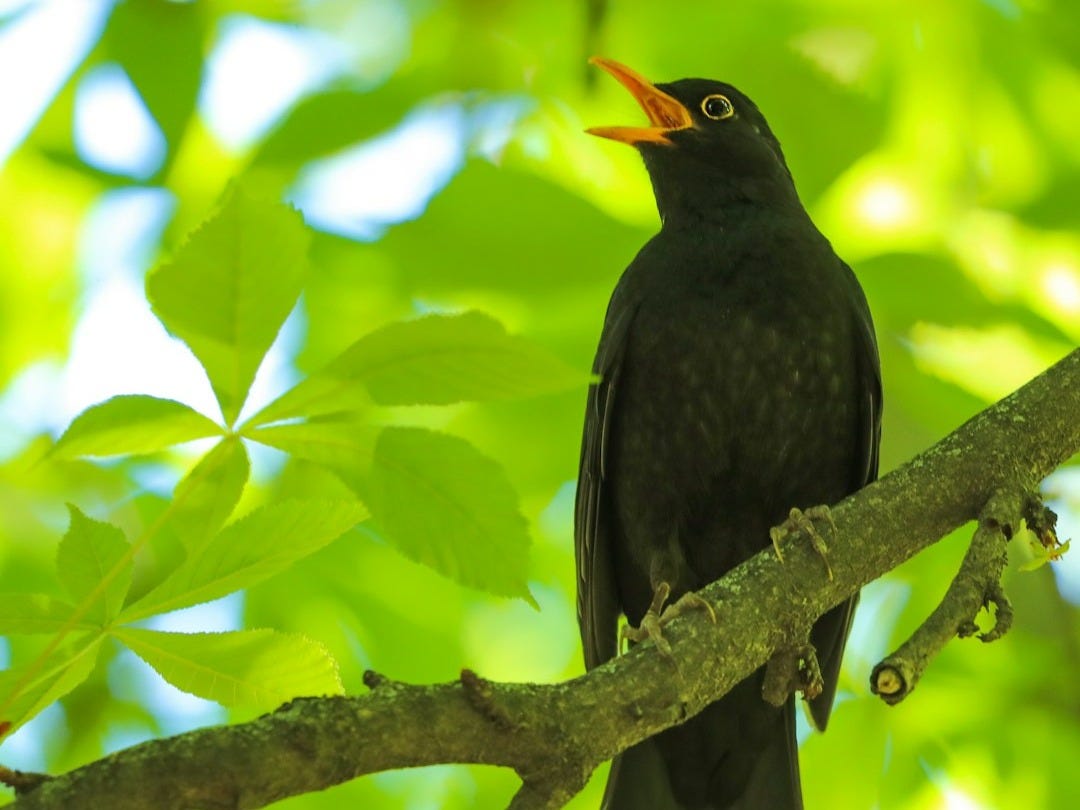
My granny loved the birds that visited her bungalow garden. She bought me membership of the Young Ornithologists Club, hoping to pass on her passion, but a million other things had my attention. Looking back, I wish I’d taken the time to listen and learn.
Walking in summer woods at dawn and dusk, music fills the air, but the myriad voices merge into a harmonic background. I long to pick out individual songs, and I envy companions who point confidently towards the canopy and name a bird.
In truth, there is only one bird whose song I can consistently identify: the blackbird. To my ears, its alto fluting melody stands apart from the higher pitched whistling and chattering of rarer songbirds.
Blackbird song, recorded by Paul Holt, XC544271
Accessible at www.xeno-canto.org/544271, licensed under CC BY-NC-SA 4.0
Male blackbirds sing from high perches, morning and evening, to mark their territory and demonstrate their prowess to potential mates. Though their song follows a familiar pattern, every blackbird has a unique musical vocabulary. Because blackbirds rarely move far from their chosen home, it’s said that with time, human ears can learn to distinguish one individual from another.
Like many birds, the song of the blackbird is not the only sound they produce. Female blackbirds will raise the alarm if their young are under threat. A cat hunting down a slow moving fledgling draws insistent, repetitive cries from her throat.
Blackbird alarm call, recorded by Guy Kirwan, XC424175
Accessible at www.xeno-canto.org/424175, licensed under CC BY-NC-SA 4.0
Around 5 million blackbirds call Britain’s hedges, woods and gardens home, and their voice has been part of the song of these islands for generations. For the ancient Celts, the blackbird was one of the oldest animals. Along with the stag of the earth and the trout of the water, its presence was intimately connected with the sky. Although Rhiannon's birds go unnamed in Welsh mythology, it is easy to imagine that it is the blackbird's peculiar, liquid, twilight song that can wake the dead and lull the living to sleep. Hopping from their hidden nests to feast on worms and berries, they slip in and out of sight, becoming creatures of liminal space as they cross from one world to another.
The blackbird's relationship with the human world has never been one-sided. If we have woven them into our mythologies, they in turn have absorbed us into theirs. Today, in cities, that absorption takes a stranger and more literal form. Urban blackbirds sing higher, louder and longer to elevate their song above the rumble of the city, exhausting themselves as they hold their space against the din. They internalise the human-made sounds of the environment too, learning to mimic sirens and folding them seamlessly into their song. Hearing this for the first time is a disconcerting experience, as the boundary between the human and more-than-human worlds dissolves in a single bird's throat, in a suburban garden on an ordinary morning.
Blackbird mimicking an ambulance siren, recorded by Peter Carr, XC626819
Accessible at www.xeno-canto.org/626819, licensed under CC BY-NC-SA 4.0
Like every voice in nature, the blackbird deserves to be heard and recognised. Its song is not made for our ears. But it is given freely, every morning and every dusk, to anyone who pauses long enough to hear it. Standing at her kitchen door, my granny understood this, even if it took me decades to catch up.
We have named the blackbird, mythologised it, absorbed its alarm calls as background noise, marvelled at its mimicry of our own sounds. But perhaps we have not done enough to simply listen to it on its own terms. What if we let it be, for a few minutes, not a symbol or a soundtrack but an individual, on a particular branch, saying something specific to the world?
If you want to learn the blackbird’s song, I recommend the website xeno-canto. It’s an extraordinary, decades-long, collective effort to record and share the sounds of the more-than-human community. But, in truth, the nearest garden or park will do just as well.
Enjoyed reading about your experiences with blackbirds, Dru. I'll be listening and wonder if I'll be one day be able to discern the calls of individual blackbird. I love your encouragement to listen to their calls on their terms...as individuals with something to say to the world.
I have been enjoying the evening song of blackbirds SO much this month. One blackbird in particular, at Pomona. A song steeped in ancient magic, if you ask me!