


Mazes are designed to disorient. Born of Renaissance rationality, mazes turned the exuberance of medieval gardens into logical puzzles. Clipped hedge mazes planted across Europe were a symbol of status and nobility, offering curious aristocrats the satisfaction of completion. The maze’s layout made its centre a goal to strive for, a perfect aim for minds seeking to impose order on an untamed world.

In English, we often use the words maze and labyrinth interchangeably, but there is an important difference between them. Technically, a labyrinth is a single unbroken path that winds from the entrance to the centre, while a maze is made of choices.
With their multicursal, head-driven paths, mazes appear so different from the heart-centred simplicity of the contemplative labyrinth. But both designs share something in common: in every labyrinth and almost every maze, there is just one path that’s worth following.
Ariadne’s thread
In myths, many heroes face the challenge of finding their way. And in venturing there and back again, as Tolkien puts it, they often need help.
In the story of the Minotaur, the princess Ariadne aided Theseus in his quest with the simple gift of a ball of thread. As he entered the labyrinth beneath the Palace of Knossos to face the monster, he let the thread fall behind him to mark his path. Even if he became lost in the darkness of the underground maze, following this thread would lead the hero back to safety.

As I’ve written before, the myth of the Cretan labyrinth makes little logical sense, except perhaps as a story told to lionise blood-thirsty conquerors. I often wonder if the labyrinth designed by Daedalus wasn’t so much a prison for a monster but rather a protective sanctuary for the starry-eyed Asterion, a child born of a mother’s passionate devotion to the gods. Perhaps King Minos commissioned a secret place where his wife Pasiphaë’s beloved son could shelter from the public gaze.
But quite aside from the human and divine drama of the story, the architecture of the myth is perplexing. Ancient labyrinths were invariably drawn as unicursal paths, so leaving them was as simple as turning around. But perhaps Theseus knew this. He certainly didn’t value Ariadne; her abandonment on the shores of Naxos shows how little he thought of her. Perhaps he held her well-meaning gift of life-saving thread in similarly low regard.
Still, the idea of following a thread has persisted in our collective consciousness. It is a powerful metaphor for finding a path through the maze of life, protecting against the perils of getting lost. If you are going to venture into the unknown, it’s good to have a thread to follow.
Don’t ever let go
Picking up a thread is an invitation to embrace curiosity about where your steps might lead. It can also be a powerful symbol of discovering a purpose that shapes your path.
I first encountered William Stafford’s poem The Way It Is during my training as a nature connection facilitator. Wondering where the path ahead might lead, the poem offered a spirit of determination that resonated with me and many others on the course. At our final celebration meal, we spoke Stafford’s words out loud as we passed an unwinding ball of string between us and watched as the thread created a web of our interconnections that bound us together.
“There is a thread you follow,” he begins.
The Way It Is is a reminder that picking up and following the thread is urgently important but not without its challenges. People will demand explanations about the purpose that is so obvious to us, but obscure for them. The thread offers certainty in the face of life’s difficulties, but holding on takes determination. The poem’s closing line - “You don’t ever let go of the thread” - feels as much a warning about the consequences of letting go as an encouragement to hold on.
I am still following the thread I picked up next to a campfire deep in Devon woodland. Over the years, it has led me to deeper explorations of nature connection, extraordinary landscapes and inspiring people. A simple poem changed me profoundly.
Going deeper
The winter months can make outdoor exploration challenging, but it’s the perfect time of year to follow the thread through the world of words. This year, I’ve steadily built up a pile of new books that caught my attention, and I’m revisiting some old favourites, too.
One book I’m currently re-reading is Follow This Thread by Henry Eliot. The book is an immersive wander through the history, culture and psychology of labyrinths and mazes. The design is remarkably beautiful. Across its pages, a single sinuous red line is drawn in loops and whorls, outlining figures and tracing the shapes of mazes, real and imagined.
The text, too, encourages you to round corners, occasionally rotating the text through ninety degrees as you move from page to page. The effect is disorienting as you turn the book in your hands and find yourself leafing backwards towards the conclusion. It is easy to get lost about which page to turn next, but I imagine this is the point.
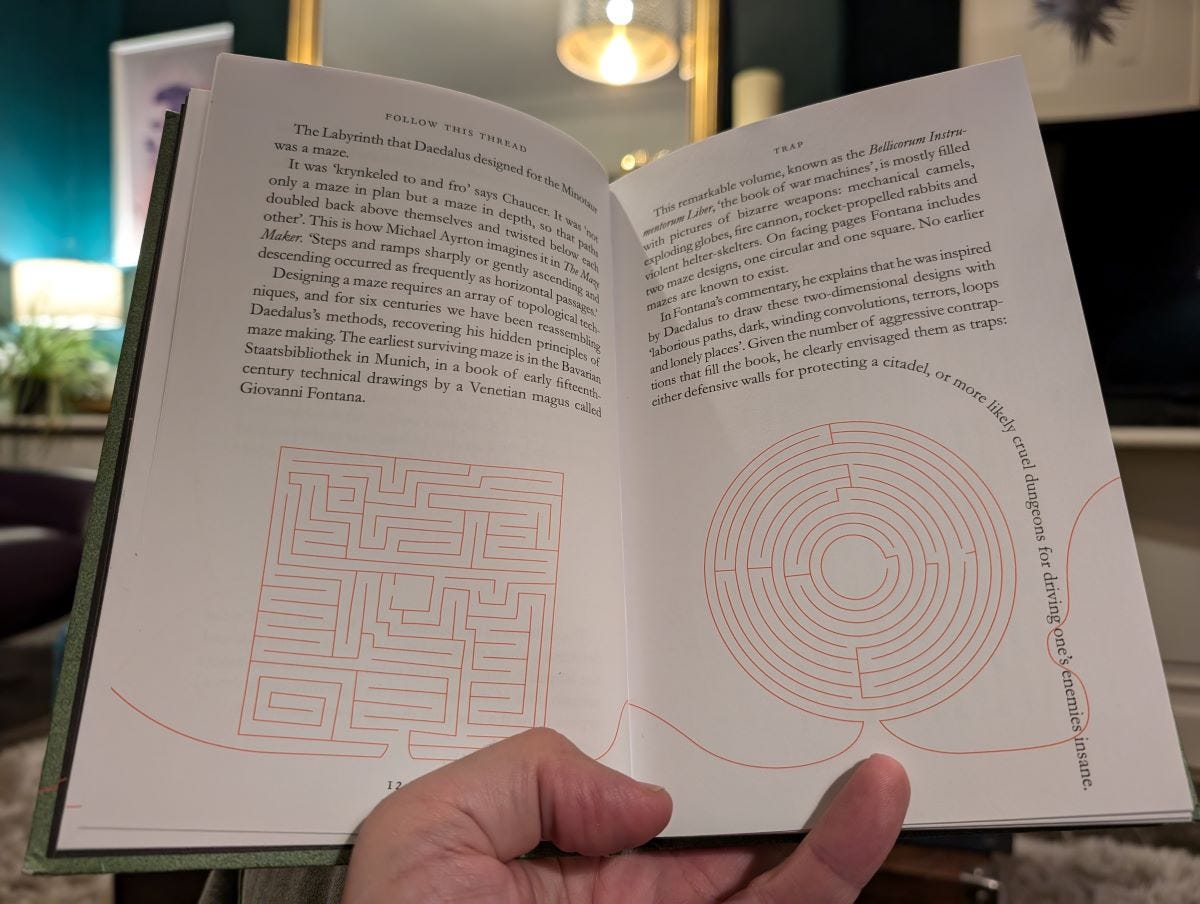
The narrative of Follow This Thread also follows the structure of a maze, taking you deeper with every paragraph. Eliot explores the maze as a trap, as the site of a quest, and even as a tomb. From the still centre at its heart, a logical dead end yet somehow filled with possibility, you can return along the path of freedom and re-enter the everyday world.
“A walker leaving a labyrinth is not the same person who entered it,” Eliot writes, and this may be true for readers of his book, too. It’s a mesmerising and enchanting experience. And if you’re looking for a festive gift for a maze lover, I recommend it.
Global threads
As Eliot clearly explains in his book, much of our shared symbolic understanding of the thread stems from Ariadne’s gift and the cord that is spun, measured and ultimately cut by the Fates. But the thread appears in folklore, too. From Russia to Portugal, there are tales of witches spinning magical cords that connect to the otherworld, fairies offering seemingly endless spools of yarn, and children lowered from the heavens on celestial strings.
In Chinese mythology, the red thread of fate binds together lovers who are destined to be soulmates. Tied at the ankles by Yue Lao, the old man under the moon, the thread can be stretched and tangled. But its uniting power can never be broken, even if a couple is separated.

The thread is also a symbol in Buddhism. Red Thread Zen, in particular, can be traced back to the 15th-century monk and poet Ikkyu Sojun. He taught that passion could offer a way to enlightenment. Ikkyu’s iconoclastic teaching, which embraced the body, sexuality and emotions as vital elements of the spiritual experience, was a striking counterbalance to the ascetic and patriarchal norms of his age.
In traditions as diverse as Kabbalah and Hinduism, the thread winds through the stuff of life, from birth to death. From the blood in our veins to the path beneath our feet, humanity follows the thread to every corner of the planet and into every facet of life.
The thread you follow
So, what thread are you following? I’d love to hear more about your experiences of mazes, finding your way and discovering your path. Feel free to comment below (if you’re reading online or on the Substack app), or drop me an email if this landed in your inbox.
In my experience, it’s OK if you don’t know where you’re going or if you look down and find that you are empty-handed. As Stafford says, any thread can be a golden thread. You just need to not pull on it too hard. Begin to notice what intrigues, fascinates and enchants you. You can let your curiosity guide you and follow the thread wherever it goes.
The maze of life can be a disorienting path to walk. You should expect dead ends, blind alleys and wrong turns. But if you persist, you’ll discover the only path worth following - your own. So don’t ever let go of the thread.
This year I went on a virtual pilgrimage in Ireland through the wonders of the internet and there was the theme of following a green thread for the duration of the pilgrimage which I then exchanged for a red thread as it ended. This post reminded me of the red thread image again. Thank you
Inspiring. I must get round to reading the Greek myths - I always get lost by the profusion of names and genealogy! I love the diea of the book which is itself structured rather like a maze. I do wonder if we invent or 'see' threads when looking back - and what we actually experienced was pure chaos- the brain's insistence on narrative threads weaving them from that chaos. I like the gentlenes sof the idea of threads and somehow I always feel much calmer with a needle and thread in my hand! Thanks for the provocations and insights.