


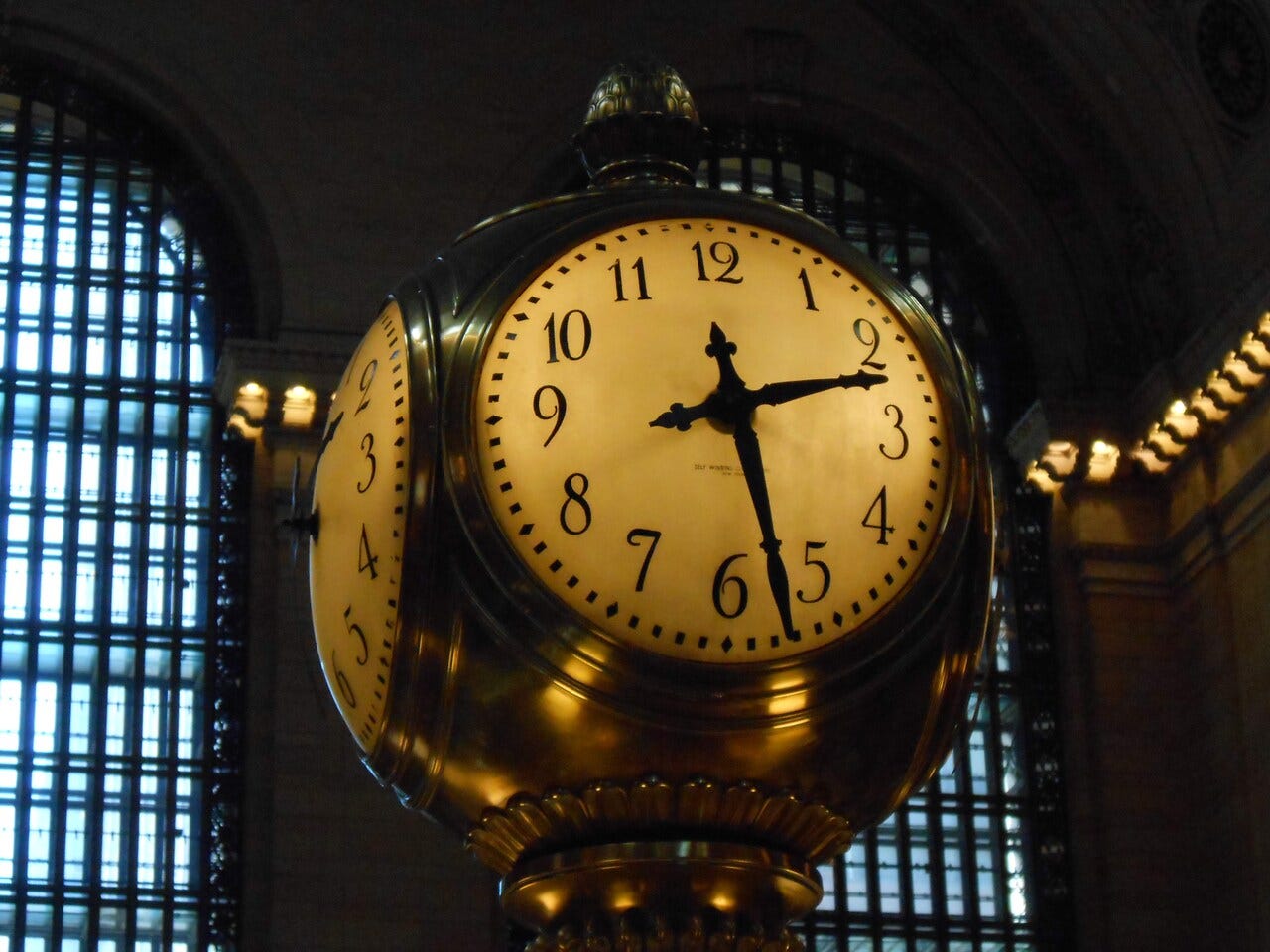
Time was against me this week. I longed to enjoy some timeless moments, but it has felt like there aren’t enough hours in the day.
Sunlit hours are dissolving into the shadows of wintry nights. Our dog Mera is anxious about venturing out after dark, so there are extra daytime walks to schedule. And, as of a month ago, I’m working full-time.
My new job - managing marketing and brand development for the UK’s largest relationship counselling service, Relate - is exciting and rewarding. But by the time my working day ends, it is dark outside. Once chores, tea and baths are done, there are precious few moments left before sleep demands my presence in the world of dreams.
Ironically, this week I had planned to write about time. I didn’t quite manage to weave my thoughts together, but here are some of the inspirations and provocations I gathered with an array of perspectives on time itself.
If you have a moment this weekend, these are good things to explore.
Natural rhythms
Daylight saving does nothing except shift our reference point by 60 minutes. Clocks changing in autumn may bring nightfall an hour sooner, yet no time is lost. We simply recalibrate.
But as Rachelle Wilson Tollemar points out in her insightful article for The Conversation, our twice-yearly argument about clocks misses the wider point that winter rest is an essential element of nature’s balance.
“We are the only species that chooses to fight against our biological presets,” she writes, “regularly changing our clocks, miserably dragging ourselves into and out of bed at unnatural hours.”
I have often wondered how it would be to live perpetually governed by the movement of sun. Though I’m not a morning person, I have had a handful of midsummer days wandering from sunrise to sunset. Hours stretch endlessly. Compared to the enclosing of winter, time becomes generous and luxurious.
This week, I have felt Tollemar’s call to embrace the rhythm of life deep in my soul. If only I had the time.
Dissolving reality
But perhaps time isn’t the rigid taskmaster I imagine it to be.
I first read Carlo Rovelli’s The Order of Time during my years of wandering. Without a permanent home or regular work, I had the freedom to slip sideways out of time, unshackled from the constraints of calendars and clocks. I lost track of days. And in truth, I sometimes lost track of reality. Life beyond time can be disorienting.
Physics and poetry are pursuits of the truth of things, and The Order of Time is the remarkable product of Rovelli’s reality-revealing wordsmithery. From his unique vantage point as a physicist with the heart of a poet, he explores how the essential nature of time is not as orderly as we might have believed.
Whenever I step over the threshold of a labyrinth, I sense myself slipping into a realm when time moves differently. Time loops and whirls, flows forward and back, pools languidly and rushes like water from a breached dam. Sometimes, it does not flow at all, but jumps from moment to moment. These various sensings of time are not only in my imagination. I am grasping something of the reality of time’s becoming.
“The difference between past and future, between cause and effect, between memory and hope, between regret and intention…” writes Rovelli. “In the elementary laws that describe the mechanisms of the world, there is no such difference.”
Rovelli’s work is not for the faint-hearted. His writing is accessible and illuminating, but his subject matter is profoundly disconcerting. Read the book with your feet firmly on the ground, and listen for the rising and falling of your breath. Even as the imagined march of time dissolves into silence, your heart somehow keeps beating.
Naming time
If you want something altogether lighter and more grounding, I recommend this video exploring the etymology of words related to time.
In it, I found out that hours and years share a common ancestor. I learned about the sennight, a word that we’ve collectively dismissed in favour of the more prosaic week. And I stumbled on a word we should definitely revive. Why do we talk about the day after tomorrow when the enchanting overmorrow languishes in a dusty corner with the dictionary’s obsolete words?
If you enjoy a gentle stroll through the world of words, I think you’ll appreciate this.
Until next time.
Overmorrow is a delightful word.
Lots to ponder on here, Dru. Thanks for sharing your thoughts. And congratulations on the new job!